The Rosicrucian Fellowship is an international organisation with numerous centres around the world. Its Italian centre is A.R.C.O. (Associazione Rosa-Crociana Oceanside).
Like the other Fellowship centres, A.R.C.O. shares the teachings that, according to the Rosicrucian tradition, the Elder Brothers of the Rosicrucian Order entrusted to Max Heindel. The Italian centre was formally established in 1973 and recognised by headquarters in 1974.
Headquarters in Oceanside
The Fellowship’s headquarters are on Mount Ecclesia in Oceanside, California, USA. They coordinate its centres and have no affiliation with other organisations that identify with Rosicrucianism.
1614–1615
The Rosicrucian manifestos
The manifestos made the principles of the teachings public and named Christian Rosenkreutz, whom the tradition identifies as the founder of the Rosicrucian Order.
1909
La Cosmogonia dei Rosacroce
Max Heindel publishes The Rosicrucian Cosmo-Conception. It presents Rosicrucian philosophy and becomes a reference work for the Fellowship.
1973
The Italian centre
A.R.C.O., the Italian centre of the Rosicrucian Fellowship, is formally established. Its purpose is to share in Italy the teachings transmitted to Max Heindel.
1974
Recognition
Headquarters recognises the Italian centre. From Mount Ecclesia in Oceanside, California, it maintains contact among the Fellowship’s centres in different countries.
From the manifestos to Max Heindel
The Rosicrucian doctrine is particularly suited to people in the West because it offers a method of development in keeping with the stage of their Christian evolution. The forerunners of these teachings stretch back into the distant past. The Rosicrucian manifestos of 1614 and 1615 are especially significant because they made public both the name of Christian Rosenkreutz, the founder of the Rosicrucian Order, and the principles of its teachings.
The Elder Brothers worked diligently in the secrecy of their small initiatory community from the founding of the Order. In the early twentieth century they chose Max Heindel, a mystically inclined occultist, to make the Order known and set out its philosophy. The Rosicrucian Fellowship was founded in that context, and its foundational work, The Rosicrucian Cosmo-Conception, was published in 1909.
A.R.C.O. activities
A.R.C.O. maintains this website, organises Rosicrucian study courses and conferences, and publishes Sentiero Rosacrociano. The magazine includes articles on philosophy, astrology, esotericism, history, science and other subjects.
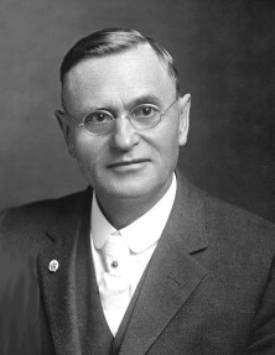
Max Heindel · Fonte del ritratto: Wikimedia Commons
The teachings and their purpose
Rosicrucianism is neither a sect nor a religion, but a school of thought with roots reaching back in time. It seeks to explain the order of life and its unfolding in a logical way, and to satisfy the needs of both intellect and heart.
The Rosicrucian teachings therefore offer a clear and rational understanding of the universe and of human beings. They encourage freedom of thought without excluding any field of science or philosophy.
One of the laws of the Rosicrucian school is that of cause and effect, expressed in the saying “we reap what we sow”. Since not every cause set in motion during a lifetime brings about its consequences within that same lifetime, its effects may also appear at another time and in another place, in accordance with the law of reincarnation, which forms part of a broad and complex system of evolution.
Rosicrucian philosophy explains how these and other principles operate and take effect. It teaches that the human being is a divine spark attending the school of life in order to evolve. To this end, each individual lives many lives in physical bodies of increasingly developed constitution, settling karmic debts and receiving karmic credits in due course.
The Rosicrucian teachings seek to help those looking for answers about human origins and nature, the meaning of life, personal and collective destiny, the significance of events, and the nature and origin of the universe.
The Rosicrucian teachings do not seek to replace Christian teaching, but to help people understand and live by it. They pursue neither political ends nor power. They seek to guide their adherents towards broader knowledge and a higher development of consciousness. They do not seek to overturn any religious order, but to understand spiritual reality more fully, imposing nothing that cannot and should not be freely accepted.

 Get to know A.R.C.O.
 Start with the Preliminary Course
 1974